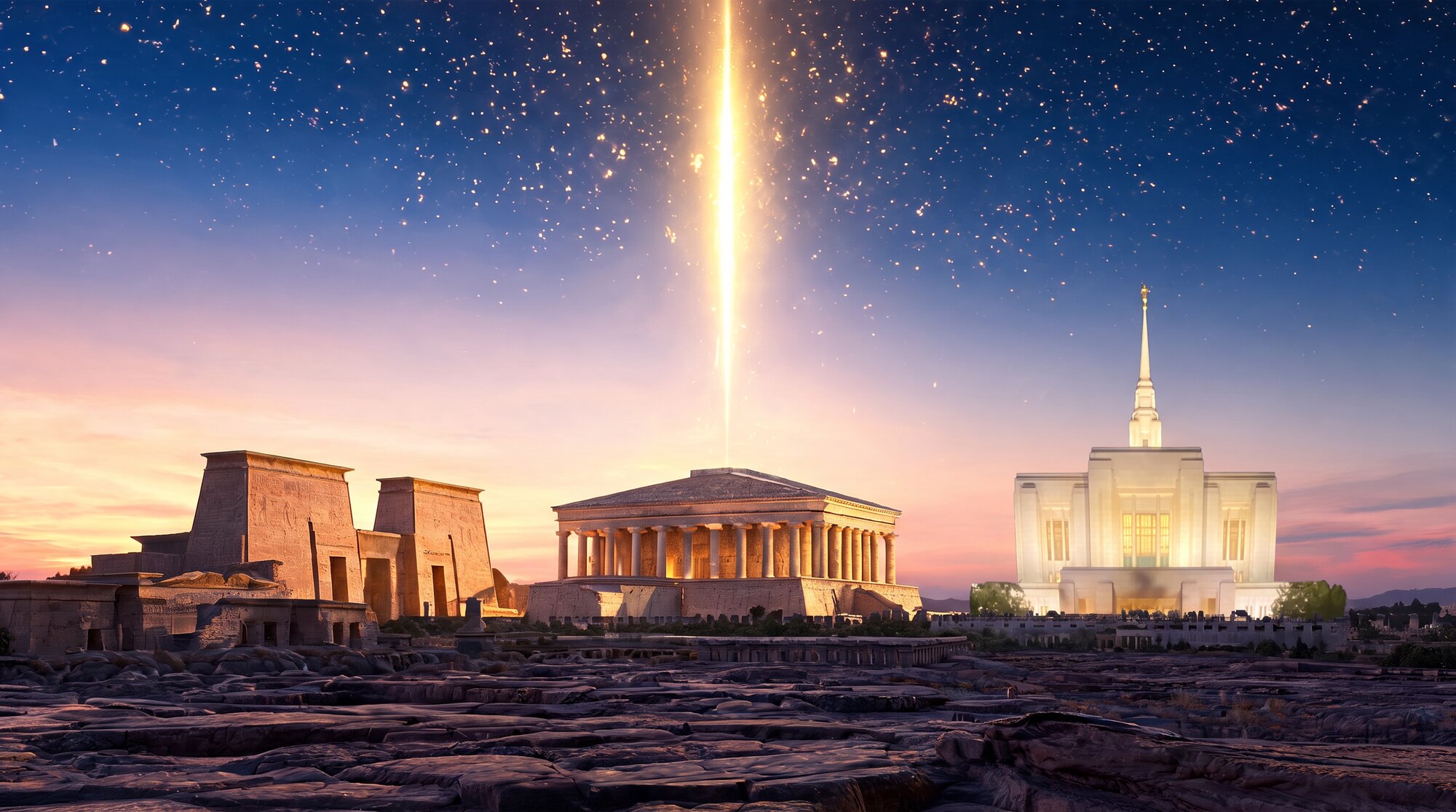
 Ogden Utah Temple photo © David Stewart
From Ancient
to Modern
Temples
How God has commissioned sacred houses throughout history — from Moses' portable tabernacle to Solomon's Temple to modern restored temples — and why that matters for us today.
Temple traditions compared — Egyptian, Old Testament, and modern LDS
Years of sacred temple tradition in scripture from Exodus to Ezekiel
Central truth — God authorizes His temples; He does not dwell in temples merely made by human hands
Does God care about temples?
Two scriptures are often quoted to argue that God has no use for physical temples: Acts 7:48, where Stephen says the Most High "dwelleth not in temples made with hands," and Acts 17:24, where Paul tells the Athenians that God "dwelleth not in temples made with hands." Read alone, these sound like a rejection of all sacred buildings.
But context changes everything. Stephen was rebuking Israel for trusting in the temple as a talisman while rejecting Christ and resisting the Holy Ghost. Paul was confronting pagan idol temples in Athens. Neither was saying God never commands a temple. The Old Testament tells an entirely different story — a story of God repeatedly calling His people to build specific, sacred structures and then filling them with His own glory.
The question was never "Is there a building?" The real question is: Who authorized it, and what is happening inside it? A temple "made with hands" in the negative sense is one designed, licensed, and controlled entirely by human tradition — not one built according to God's revealed pattern and filled with His covenants and Spirit.

What God says about sacred space
From Exodus to 1 Corinthians, scripture consistently ties God's covenants to real sacred places and ordained ordinances.
"And let them make me a sanctuary; that I may dwell among them."
God's first command to build a sacred structure. He is not confined to it — He chooses to meet His people there.
"The glory of the Lord had filled the house of the Lord. And the priests could not stand to minister because of the cloud."
At the dedication of Solomon's Temple, God fills it with His presence, confirming divine authorization.
"Howbeit the most High dwelleth not in temples made with hands; as saith the prophet, Heaven is my throne, and earth is my footstool."
Stephen quotes Isaiah to rebuke Israel's hypocrisy — trusting the building while rejecting Christ — not to eliminate temples.
"God that made the world and all things therein… dwelleth not in temples made with hands."
Paul speaks to pagan Athens where idol temples were everywhere. His point: God cannot be manufactured or confined by human religion.
"But Christ being come an high priest… by a greater and more perfect tabernacle, not made with hands."
Christ's heavenly ministry fulfills the temple pattern — it does not eliminate it. The tabernacle symbols find their meaning in Him.
"Else what shall they do which are baptized for the dead, if the dead rise not at all? why are they then baptized for the dead?"
Paul's reference to baptism for the dead — performed in temples today — shows Christ's saving work reaches beyond the grave.
A timeline of God-commissioned sacred space
From the portable wilderness tabernacle to modern restored temples, the pattern of God calling His people to build sacred houses is woven through all of scripture.
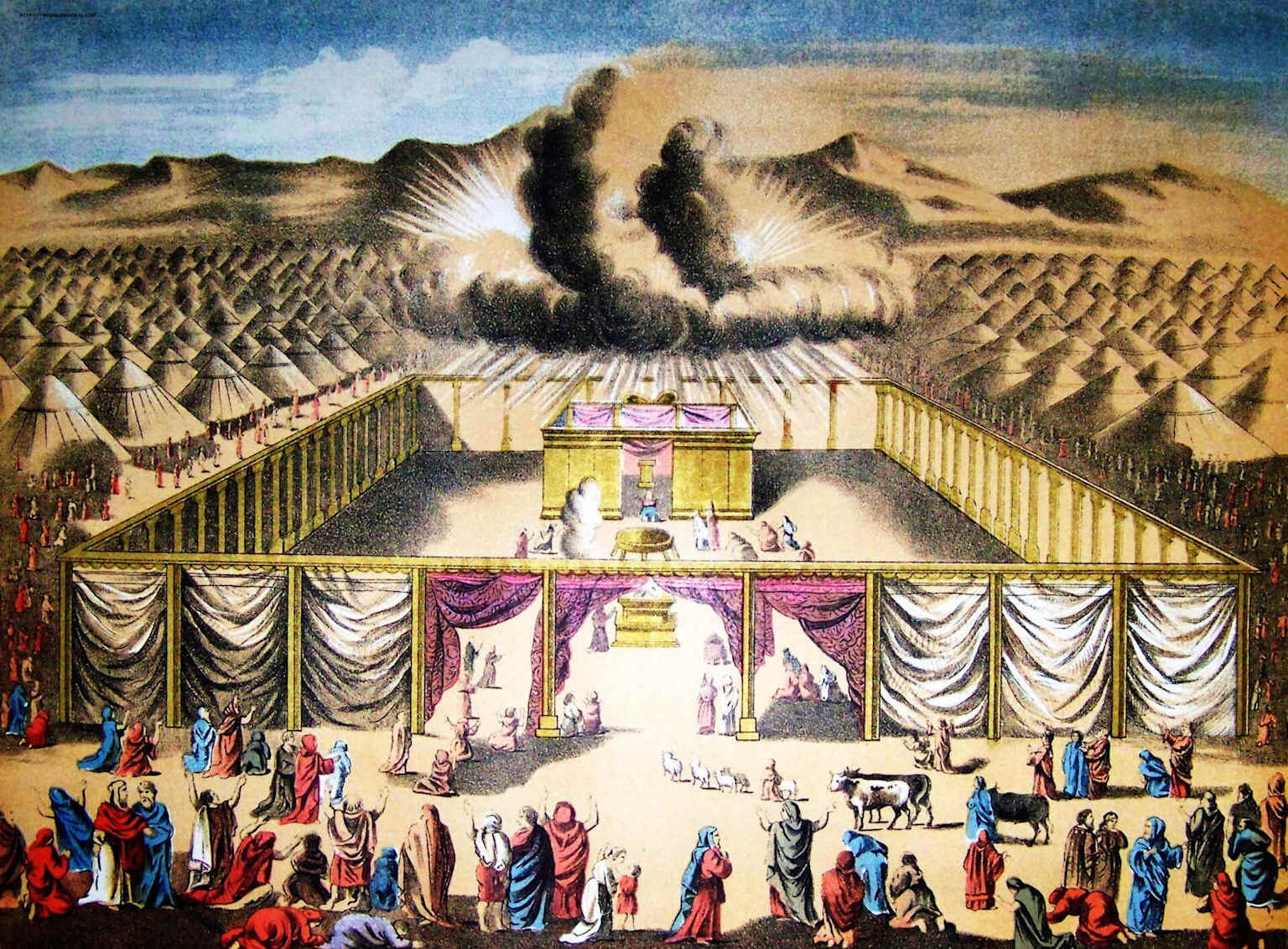
Moses and the Tabernacle
In Exodus 25–31 and 35–40, God gives Moses extraordinarily detailed instructions for a portable tabernacle — measurements, materials, furnishings, and priesthood ordinances — so that He can "dwell among" Israel. This is a physical structure built by human hands, but every detail comes from God. At its dedication, the cloud of the Lord covers the tent and His glory fills the tabernacle so completely that Moses cannot enter.
The three-tiered structure — courtyard, Holy Place, and Most Holy Place — embodies the principle of progressive holiness: moving from the world toward God's presence through cleansing, ordinance, and covenant.
Solomon's Temple in Jerusalem
King Solomon builds the first permanent Temple in Jerusalem according to divine design inherited from his father David, who received the pattern from God. The result is stunning: cedar, gold, carved cherubim, and the Ark of the Covenant in the Most Holy Place. At its dedication, the glory of the Lord fills the house so powerfully that the priests cannot stand to minister.
Even Solomon acknowledges that God cannot be contained: "The heaven and heaven of heavens cannot contain thee; how much less this house that I have builded" (1 Kings 8:27). The temple is not a cage for God — it is a place God chooses to meet His covenant people.
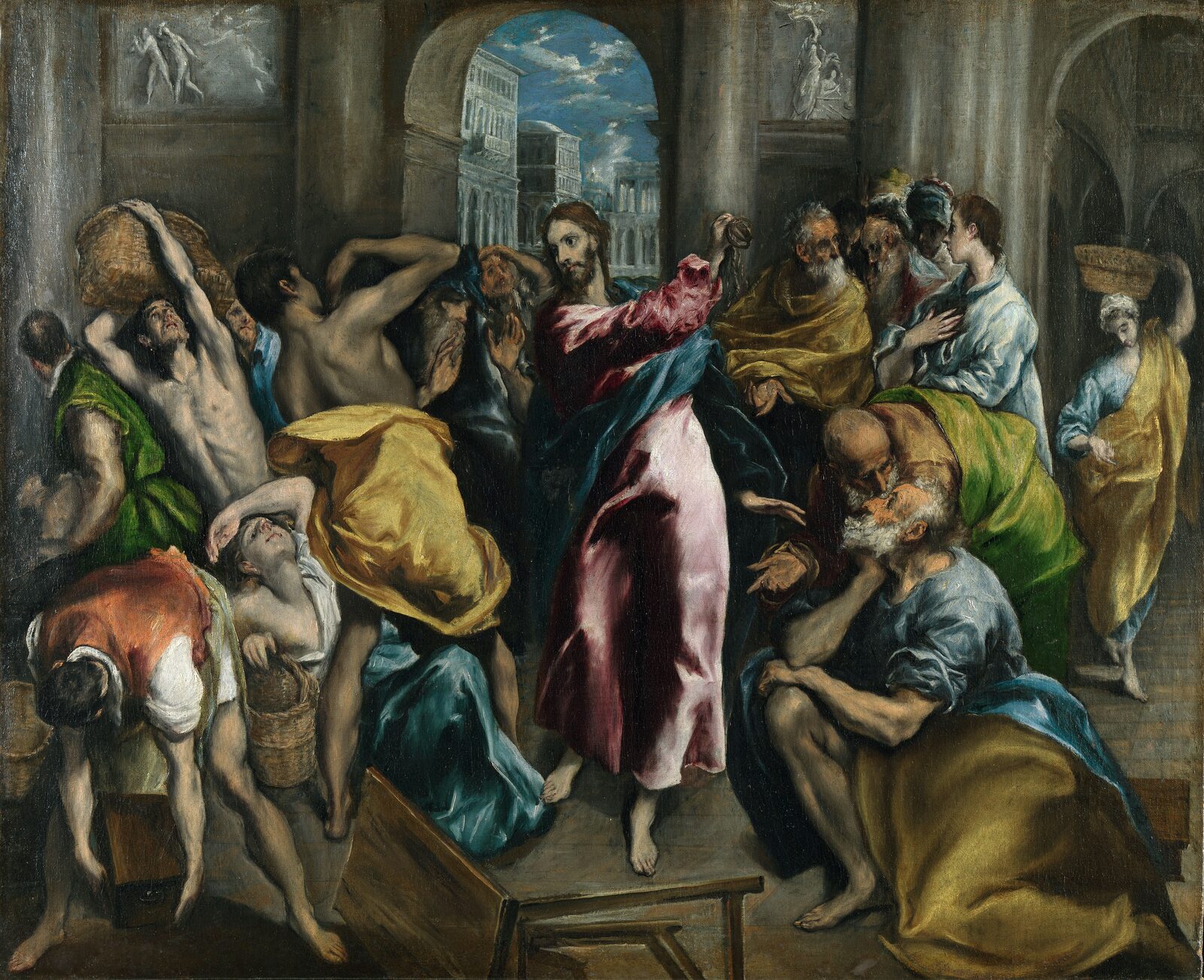
Jesus Cleanses the Temple
By Jesus' day, the courts of the Jerusalem Temple are being used for commercial exchange — buying and selling animals for sacrifice and changing foreign coins. Jesus overturns the tables of the money changers, drives out the merchants, and declares: "My house shall be called the house of prayer; but ye have made it a den of thieves."
The word "My house" is crucial. Jesus does not say the Temple is wrong or obsolete. He reclaims it. The problem is that an authorized, sacred house has been corrupted by human greed and spiritual hypocrisy. This is the very pattern warned against in Jeremiah 7 (treating the building as a magic protection while living wickedly) and Ezekiel 8 (idolatry inside the temple courts).

A Future Temple in Jerusalem
The Bible does not merely look backward at temples — it looks forward. Ezekiel 40–48 contains a detailed prophetic vision of a future, glorious temple in Jerusalem. This vision undercuts the idea that all temple worship ended in the first century; instead, scripture anticipates renewed worship and covenant, with God dwelling among His people again in a divinely authorized sacred space.
Latter-day Saints believe God can still appoint holy houses, just as He did in Moses' and Solomon's day, and that ultimately there will indeed be a temple in Jerusalem. Modern temples are part of that continuing story.
Modern Latter-day Saint Temples
Latter-day Saints believe that God restored priesthood authority and temple ordinances through the Prophet Joseph Smith, as prophesied. Modern temples recover the biblical three-tiered movement toward God's presence: baptistry, instruction and ordinance rooms, celestial room, and sealing rooms. These ordinances include baptism and other work performed on behalf of deceased ancestors, reflecting the New Testament suggestion (1 Corinthians 15:29) that Christ's Atonement reaches beyond the grave.
Because ordinances in these temples are performed under restored priesthood keys, they are not "made with hands" in the negative sense — they are built by human hands but patterned, authorized, and spiritually filled by God.
When authorized temples become corrupt
From house of prayer to den of thieves
Scripture does not merely describe God-commissioned temples. It also warns of what happens when people corrupt them. The pattern runs throughout the Old Testament and reaches its dramatic climax with Jesus himself.
"The temple of the Lord, The temple of the Lord, The temple of the Lord, are these. But will ye steal, murder, and commit adultery...?"Jeremiah 7:4, 9
In Jeremiah's time, people chanted "The temple of the Lord" as if the building itself guaranteed divine protection. God rebuked them sharply: the temple was not a talisman for an unrepentant people. In Ezekiel 8, God shows the prophet abominations and idolatry happening inside the temple courts and hidden chambers. His glory departs — a once-authorized house becomes spiritually empty.
"My house shall be called the house of prayer; but ye have made it a den of thieves."Matthew 21:13
By Jesus' day the pattern of corruption was complete: the sacred courts had become a marketplace. Jesus overturns the tables and drives out the merchants. Notice He calls it My house — He does not reject the idea of a temple. He reclaims and purifies the temple God originally authorized. The lesson is not "no temples," but "corrupt temples grieve God, and He acts to purify them."
This same principle explains why temples in human history — when separated from revelation and priesthood authority — slowly drift from their divine purpose: the human tendency to turn covenant space into cultural performance, commercial use, or status symbol is always present when the authorizing power is absent.
Scriptures often misapplied against temples
Several scriptures are frequently quoted as proof that God rejects all physical temples. Here is the context that changes the picture.
"God dwelleth not in temples made with hands" (Acts 7:48, 17:24) — therefore no physical temple is needed today.
The context: Stephen (Acts 7) was addressing Jews who were clinging to the Temple while stoning prophets and rejecting Christ. Paul (Acts 17) was speaking to pagan Athenians surrounded by idol temples. Neither was speaking to members of a restored church about divinely commissioned sacred houses.
The phrase "made with hands" in Greek (cheiropoiētos) was a well-understood idiom for idol temples — humanly invented sacred systems. It is the same word used in Isaiah's critique of idols. It does not condemn every sacred structure — it condemns unauthorized, human-invented religion that tries to house or manipulate God.
The Old Testament answer: God Himself commands the Tabernacle (Exodus 25) and the Temple (1 Kings 5–6), fills them with His glory, and calls them "My house." These were made with human hands but under God's authority. That is the distinction that matters.
"Believers are the temple of God" (1 Corinthians 3:16) — we are the temple now, so physical temples are obsolete.
The context: Paul is writing to the Corinthian church, which was divided by factions. His point is that the community of believers is God's dwelling place by the Spirit — not that a dedicated sacred building is wrong. He is not addressing temple ordinances at all.
Notably, in the very same letter (1 Corinthians 15:29), Paul refers to people being "baptized for the dead" without condemning the practice — strong evidence that covenant ordinances in a sacred setting were part of early Christian life.
Both can be true: God dwells in His people and He chooses to meet them in authorized sacred spaces. The personal temple and the physical temple serve complementary purposes, just as the priesthood and the covenant both exist together.
Temples are monuments to pride and wealth — idols of gold and marble (cf. Revelation 9:20).
The concern is real and valid: Revelation 9:20–21 condemns people who "did not repent of the work of their hands" and who worship "idols of gold, silver, bronze, stone and wood." Any temple that glorifies human ego, wealth, and status has violated its purpose — just as the Jerusalem Temple did in Jeremiah's and Jesus' day.
The distinction: Scripture consistently separates idols (human inventions worshiped instead of God) from God-commanded structures (the Tabernacle and Temple, built to God's design for His covenants). God Himself commanded cedar, gold, and precisely worked stone for the Tabernacle and Temple — not because He admires luxury, but because craftsmanship and care in His house reflect the seriousness of covenant. What matters is Who authorized it and what happens there.
Latter-day Saint temples are not monuments; they are functional covenant houses. What happens inside — baptism, endowment, sealing, proxy work for the dead — is entirely centered on Jesus Christ, not on the beauty of the building.
Christ was born in a stable. He owned nothing. He would never approve of expensive temples.
The point about Christ's humility is true and important. He was born in humble circumstances, owned nothing, ate with the poor, and warned constantly against greed and pride. These are not peripheral points — they are central to who He is. Any temple that forgets this has lost its way.
But humility and authorized sacred space are not opposites. The same Christ who was born in a manger also said "My house shall be called the house of prayer" and drove corruption out of the Temple with righteous force. He did not demolish it; He purified it. He attended it, taught in it, and called it His Father's house.
The worth of a temple, in our view, is not in its marble or spires — it is in the covenants made there, the prayers offered there, the families sealed there, and the Savior honored there. If a temple ever shifts from those purposes to pride and display, the warning of Jeremiah applies as directly to us as it did to ancient Israel.
Temples have always been about covenant — binding people to God and to each other in ways that last beyond this life.
"Temples made with hands" fail not because they are physical, but because they lack the divine authority and revelation that animate God's true house.
Proxy work for the dead — including baptism — extends the reach of Christ's Atonement across generations, binding families eternally.
Three temple traditions compared
Egyptian, Old Testament, and modern LDS temples share structural patterns but differ fundamentally in authority, covenant, and purpose.
| Feature | Egyptian Temples | Old Testament Tabernacle / Temple | Modern LDS Temples |
|---|---|---|---|
| Purpose | Dwelling of deity; priestly rites; cosmic maintenance | Dwelling of God; sacrifice, atonement, and covenant | House of the Lord; covenants, eternal family, ordinances for living and dead |
| Authority Source | Pharaoh and priestly tradition; human cultural development | Direct divine revelation to Moses, David, Solomon | Restored priesthood keys; direct revelation to living prophets |
| Structure | Pylon → Courtyard → Hypostyle Hall → Inner Sanctuary (Naos) | Court → Holy Place → Holy of Holies | Baptistry → Instruction / Ordinance Rooms → Celestial Room → Sealing Rooms |
| Symbolic Journey | From profane outer world toward gods; resurrection and rebirth | From the world toward God's presence through cleansing, sacrifice, and atonement | From the world to God's presence through Christ's Atonement; creation, fall, and redemption taught symbolically |
| Central Image | Statue of deity (cult image) | No image; Ark of the Covenant | No image; focus on Jesus Christ and His Atonement |
| Access | Restricted by priestly rank; public excluded from inner areas | Priestly progression; High Priest alone enters Holy of Holies | All worthy, prepared members; no priestly class distinction beyond ordinance office |
| Covenant Making | Initiation rites, priestly oaths; tied to cosmic mythology | Mosaic Law, sacrifice, Day of Atonement; Sinai covenant | Baptism, endowment, sealing; centered explicitly on Jesus Christ |
| Role of Family | Ancestral cult; limited family dimension | Lineage and priestly inheritance; not central to temple function | Central — eternal families, proxy work for deceased ancestors across all generations |
| Work for the Dead | Offerings and prayers for the deceased; tied to Osiris myth | Sacrifice and intercession; some ancestral concern | Proxy baptism and ordinances for deceased ancestors (cf. 1 Cor. 15:29); core mission of modern temples |

Modern temples and the biblical pattern
Latter-day Saint temples consciously recover the biblical three-tiered movement toward God's presence and covenant. They are not invented from whole cloth — they follow a revealed pattern that mirrors the Tabernacle, the Temple of Solomon, and the ordinances described throughout scripture.
-
Baptistry on Twelve Oxen
Echoing Israel's twelve tribes and the "molten sea" of Solomon's Temple (1 Kings 7:23–26). Proxy baptisms are performed here for deceased ancestors.
-
Instruction and Ordinance Rooms
The endowment teaches the plan of salvation — creation, the Fall, the Atonement — and allows participants to make covenants directly with God.
-
Celestial Room
The holiest space, representing entering God's presence. Open to all worthy participants — there is no priestly exclusivity. It corresponds to the Holy of Holies.
-
Sealing Rooms
Marriages and family relationships sealed for eternity — an expansion of temple purpose beyond individual salvation to multi-generational family unity.
A personal witness
I've served as a temple worker for more than a decade, and during that time I've witnessed countless small but sacred miracles and felt the Lord's Spirit — and the spirit of those we serve — in ways that are impossible for me to deny. For me, these experiences are a quiet but unmistakable witness that this truly is His house and His work.— Site Author, Temple Worker for 10+ Years
I created this website after attending a lecture about ancient Egyptian temples at BYU Education Week. The speaker walked through the three-tiered structure of Egyptian sacred architecture — pylon gate, courtyard, hypostyle hall, inner sanctuary — and I was struck by how closely it mirrored the structure of Moses' Tabernacle and Solomon's Temple, and then our own modern temple pattern.
That observation raised a question worth exploring carefully: what does it mean when a human religious tradition mimics the pattern of God's revealed sacred architecture? Does similarity mean common origin? Or does it reveal something about the deep human longing for the divine pattern — a longing that, without God's revelation and authority, produces impressive but ultimately unauthorized imitations?
I am a lifelong member of the Church of Jesus Christ of Latter-day Saints, born in Los Angeles in 1955, now living in Ogden, Utah. I am not a theologian or academic. I am someone who loves the scriptures, loves the temple, and believes that comparing these traditions honestly — including the hard questions — strengthens rather than weakens faith. I believe God has always wanted to dwell among His people in sacred covenant space, and that He has restored that possibility in our day through the Restoration.
If you have questions, disagreements, or simply want to explore further, you are welcome here. Honest inquiry is not the enemy of faith — it is often the road toward it.
Visit Ancient2ModernTemples.today